AI chatbot for specialty e-commerce stores
Specialty stores lose sales from unanswered fit questions after hours — not from a thin catalog. Why an FAQ chatbot fails, and how to ground an assistant in your assortment.
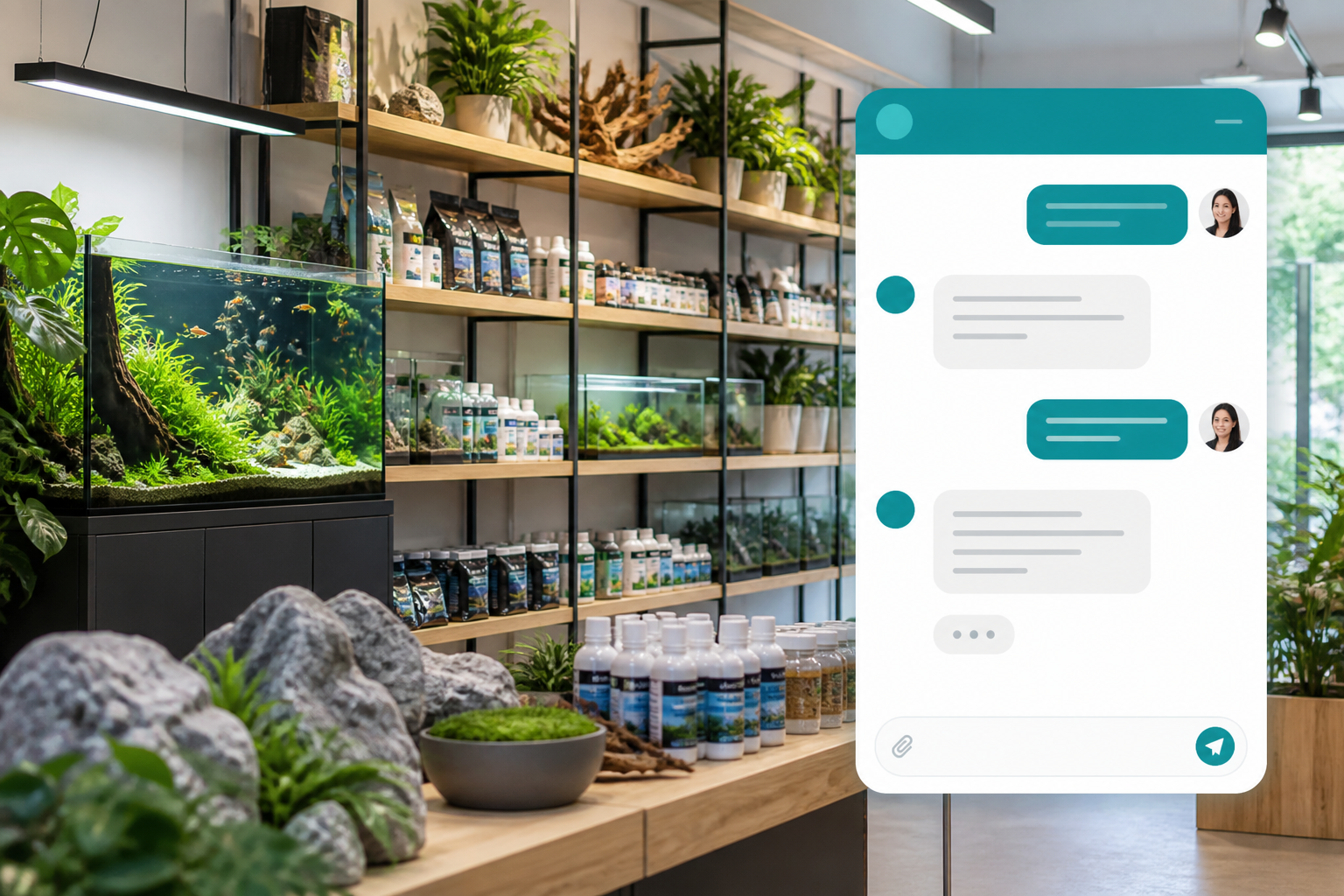
A shopper opens a reef store at 10:14 p.m. They have a 240 l tank, a Malawi stocking, a budget around 400 PLN, and one question: which filter will not be undersized in six months. They are not looking for the returns policy. They are looking for fit — whether this SKU works with *their* setup.
If nobody answers, they will not file a ticket for the morning. They will go back to Google and buy from whoever can say, in that minute: yes, this model; no, that one has too little flow; add this media, not that one.
This is not a “we lack chat on the site” problem. Most stores already have a widget. The problem is that the widget can recite FAQ, while a specialty shopper is asking a compatibility graph that FAQ never captured.
The store is open. The team is not.
Ecommerce traffic does not stop at 6 p.m. The shift does.
Gorgias Ecom Lab (July 2026) finds that, on merchant data, a median 53% of pre-purchase questions arrive outside business hours (each store’s local clock, Monday–Friday 9 a.m.–6 p.m.; everything else — including weekends — is after hours). One in five lands on a weekend. Questions that decide a purchase skew even later than support in general.
The damage is not “a slightly slower reply.” During business hours, median first response on a buying question is 2.2 hours. After hours it stretches to about 15 hours — a queue roughly seven times slower. The worst moment is not the middle of the night. It is late afternoon, right after the team stops taking new work. A question at 4 p.m. waits until morning the same way a question at 11 p.m. does.
Salesforce’s State of the Connected Customer reports that 83% of customers expect to interact with someone immediately when they contact a company. In specialty retail, “immediately” is not an autoresponder. It is: does this filter, this light, this food fit *my* setup.
CSAT usually will not show the leak. Gorgias measures positive CSAT on pre-purchase tickets at 86% during hours and 85% after hours. Almost no gap — and that is the tell, not the comfort. The survey reaches people who stayed long enough to get an answer. The shopper who asked at 10 p.m., did not wait, and bought elsewhere is not “unhappy in the dashboard.” They are missing from revenue.
Why specialty is harder than fashion
In apparel, many pre-purchase questions collapse to a size chart, a table, and a returns policy. In reef, pet and garden the question is conditional: *it fits if*.
The customer is not buying “a filter.” They are buying flow for a stocking, noise for a bedroom, replacement media you already sell, and confidence they will not rip the setup out in three months. That is a graph: product × tank × livestock × budget × what already sits on the cabinet.
Three conversations FAQ will not cover:
Reef / aquatics. “240 l Malawi, budget ~400 PLN — Oase BioMaster 250 or Fluval 307?” You need flow, service, media, and what is *in your* warehouse, not a 2019 review. Or: “Will this LED cover SPS at 60 cm?” — PAR, hanging height, spectrum. A generic model will say something plausible. The store has to say whether *this* SKU on the product card actually covers it.
Pet. “Four-month Labrador puppy, sensitive stomach — which food from your range, no chicken?” That is not a tag search for “food.” It is ingredients, life stage, exclusions, and bag sizes you actually have in stock.
Garden. “East-facing balcony, 30 cm pots, herbs through winter under a lamp — which of these two, and which fertiliser?” Exposure, pot volume, growth stage. The shopper will compare two cards and still ask a human, because they are afraid of killing the plant.
In these categories, “contact us” means “the sale goes back to Google.” Knowledge lives in sellers’ heads and last season’s inbox. A new hire takes months. A chatbot that cannot see the catalog only reprints that gap in a chat UI.
Where a generic chatbot breaks
A typical “AI” widget on a storefront does one of three things — all expensive in a niche assortment.
It recites FAQ. Opening hours, shipping cost, how to return. Useful, but those are not the questions that stall a specialty cart.
It guesses from a general model. An LLM without your product cards will invent compatibility you do not sell, recommend SKUs you never stocked, or quote a dose from another label. In reef and pet, a hallucination is not only bad UX — it is a risk to an animal or a tank. A customer who once got a confident wrong answer will not come back to “correct the ticket.”
It shouts with a popup. Baymard usability research finds that site-initiated chat (auto-open, stacked overlays) is perceived as annoying and distracting — while the same chat is useful when the user already has a specific question. In a specialty store, a “Hi! Need help?” overlay on a product page someone has been reading for five minutes does not raise conversion. It interrupts the fit decision.
A fourth, quiet failure: the bot does not know stock and variants. It recommends a filter you are out of. Or it pushes the 250 when the shopper would take the 350 because the “advisor” cannot see that the 250 sold out this evening. That is not AI. That is search unplugged from inventory.
What “catalog-aware” actually means
The point is not a bigger model. It is where the sentence comes from.
An answer should be grounded in three layers the store already has:
- Product cards — names, specs, the copy you wrote (flow, ingredients, intended use, limits).
- Stock and variants — what can go in the cart *now*, not what a wholesaler listed last year.
- Store knowledge and policies — livestock shipping, fertiliser returns, “we do not recommend X with Y,” manufacturer PDFs you put in the knowledge base.
Only then can chat do what the shopper opened it for: show specific products in the thread, with reasoning, and shorten the path from question to cart. “Model A fits because …; B if you want it quieter; A is in stock.”
Equally important is when the assistant must stop faking certainty. A question about fish disease, medication dose, “will this coral survive Friday shipping” is not a place to improvise. A good setup says: I do not know / this needs a human — and hands the thread to an operator with context (tank, SKUs, what already failed in chat). A bad bot either invents or dumps everything to “email us,” which is the 15-hour gap again.
Handoff is not automation failing. It is the condition for automation. You automate repeatable catalog fit. Humans keep exceptions, claims, and cases where being wrong costs more than a ticket.
How to measure whether it works
After-hours CSAT, as Gorgias shows, can be almost flat while revenue walks out. Do not only measure the people who waited.
A practical set for a specialty store:
- Share of pre-purchase questions after 6 p.m. and on weekends. If you do not log question hour, you are blind to half of demand. Gorgias’ median is 53% outside Mon–Fri 9–6 — hobby categories people browse from the couch often run later.
- First response after hours vs. during the day. If evening means “see you in the morning,” you have the same ~15 h median cliff.
- Automation rate — share of conversations closed without a human. That is not “the bot sent a message.” It is threads where the shopper got a fit answer and did not wait for an operator. Gorgias reports higher shopping-assistant self-resolution after hours (about 91% of pre-purchase with no handover) than during the day — more questions, a smaller share escalated, if the knowledge is in the system.
- Conversion of sessions with a conversation vs. without, especially on pages where people already linger (filters, lights, veterinary diets).
- The Monday inbox. A pile of “I asked on Saturday about compatibility” is not a support backlog. It is yesterday’s abandoned carts.
Gorgias also reports that 55% of AI-assisted revenue in their sample comes from conversations that *started* after hours. That is not proof every store will see the same split — the study is associative, on platform merchants, with attribution only where the assistant was on. It is still a strong reason not to treat the evening as dead support.
Checklist: before you paste another widget
Before you buy an “AI chatbot,” walk this list. If you miss a point, the widget is a prettier FAQ.
- Write down 20 real questions from last month — email, Messenger, chat, marketplace. If most are fit (compatibility / dose / kit) rather than “where is my parcel,” you need a catalog, not a script.
- Fix the cards. Missing flow on a filter, ingredients on a food, or intended use on a fertiliser means the model has nothing to cite. Content first, then AI.
- Connect the catalog, not only the About page. Crawling FAQ does not replace SKU, price and stock. Know whether sync is near-realtime (e.g. webhooks) or a snapshot — and what happens when something sells out at night.
- Define what the bot must not advise. Medication, disease, “will it survive shipping,” claims — straight to a human.
- Handoff with context. The operator should see tank, SKU and chat history. “Someone wrote something overnight” is not handoff.
- On-demand chat, not an overlay. Baymard: useful for a question, harmful when it interrupts. Specialty shoppers read the card. Do not cut them off.
- Measure automation rate and after-hours conversion, not only bot message count. “I don’t understand, email us” is not automation.
None of this requires a night shift. It requires knowledge to stop living only in people’s heads.
Sources
- Gorgias Ecom Lab — “Your team is sleeping on 53% of shopper questions” (July 2026). Median 53% of pre-purchase questions outside Mon–Fri 9–6; FRT 2.2 h vs ~15 h; AI agent reply ~23 s; 55% of assisted revenue from after-hours conversations; CSAT 86% vs 85%. Methodology and caveats (CSAT survivorship, no causality) are in the source article.
- Salesforce — State of the Connected Customer: 83% of customers expect an immediate interaction when they contact a company.
- Baymard Institute — CRO / live chat notes: non-user-initiated chat is often irritating; the same channel is useful for a specific question.
Reef / pet / garden examples in this piece are domain illustrations, not sample statistics.
Asellio
We built the assistant for this job: fit questions from the store catalog, not from a generic model. You paste a JavaScript snippet on the storefront. Answers come from product cards and the knowledge base (FAQ, PDFs, articles). Shopify syncs the catalog near-realtime (webhooks); BaseLinker is in beta; WooCommerce and other platforms are connect-and-sync, without Shopify’s same realtime path.
The assistant can show product cards in the thread. When the topic exceeds automation, the team takes over in Live Inbox (Growth and above). Pro adds form and email ticketing — ticket number, status, product and order context in the panel; that is support context, not order editing or an OMS. Analytics tracks automation rate, not only message volume.